Have you ever looked up at the clock and thought, Where has the day gone?!
Or maybe you finished what FELT like a long, BUSY day of work, only to feel like nothing meaningful actually moved forward.
SPOILER ALERT: That is not laziness or incompetence. It is what one of our most esteemed podcast guests refers to as [ADHD] Time Anxiety.
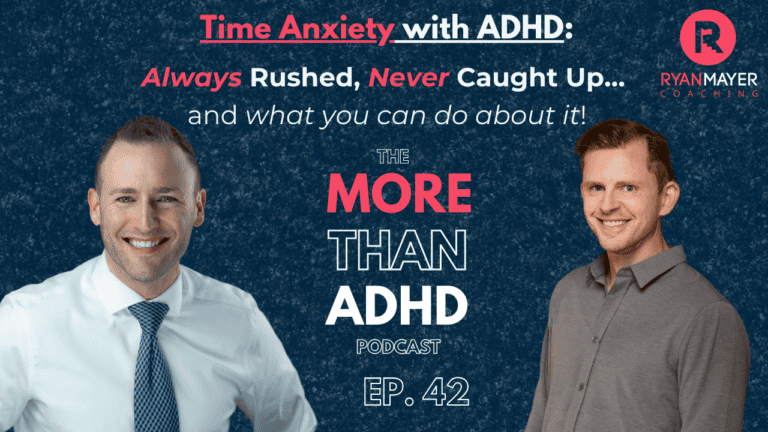
In Episode #42, Time Anxiety with ADHD: Always Rushed, Never Caught Up… and What You Can Do About It, I sat down with Chris Guillebeau to unpack why time can feel slippery, unforgiving, and chronically urgent for adults with ADHD.
This conversation goes deeper than time management tips. We explore the emotional weight of ADHD time anxiety and how to shift from constant urgency to intentional momentum.
What Is ADHD Time Anxiety?
ADHD time anxiety is the persistent fear that you are running out of time, falling behind, or missing something important. (Sound familiar?!?) 😰 (Same here.)
It often shows up as:
- A constant low-grade stress
- Difficulty relaxing
- Guilt when resting
- Starting many things but finishing few 😭
- Feeling rushed (even when you are technically “on schedule”!)
For many adults, this anxiety is deeply connected to ADHD time blindness and why it makes days disappear. When your internal clock is unreliable, your nervous system compensates with pressure. That pressure can become chronic.
And when chronic urgency combines with executive function strain, it often leads directly into Wired and Tired ADHD burnout.
What Time Anxiety Looks Like for ADHD Adults
Time anxiety is not just being or feeling “busy.” It is the persistent sense that you are always behind, even when you feel like you are working as hard as you possibly can.
It can show up as:
- Feeling rushed – even on lighter days
- Ending the day with mental leftovers and unfinished loops
- Doing a ton of tasks but not feeling progress
- Carrying pressure that never fully turns off
***Author’s Note: OK, quick timeout here – (I’ve literally never done one of these before. Wait, did he just “call timeout” in the middle of his own blog…? Is that allowed?? It’s my blog, so I’m giving myself permission to, yes.) I don’t think I’ve ever written something that is as simultaneously cathartic as it is triggering, while also super relevant for my readers. (Sigh) OK, I feel better. Now back to the show!***
This is why so many ADHD adults are drawn to planning tools, apps, and productivity systems, and still feel stuck.
In the episode, Chris explains something that is both validating and clarifying: you cannot manage time, but you can change how you relate to it.
Why “Time Management Tips” Often Fail ADHD Brains
A lot of mainstream advice assumes the problem is motivation or discipline.
But ADHD time challenges are often driven by:
- Time blindness
- Working memory overload
- Decision fatigue
- Task initiation friction
- Perfectionism pressure
In other words – and I really need you to hear this – it is not that you don’t care or don’t want to get the tasks done! No, it is just that our neurodivergent brains need structure that reduces friction, not strategies that depend on willpower. 👎
This is also why many ADHD adults benefit from tools that are visual and simple, like pen and paper, especially when the goal is to reduce cognitive load.
If you want a brain-friendly starting point for building that structure, you can check out the ADHD Productivity Guide here: ADHD productivity strategies that actually work for ADHD brains. (BTW / FWIW: All of the resources that I share in my blogs are things that I developed as solutions to challenges that both me or my clients were facing.)
Two Types of Time Anxiety (And Why Both Matter)
Chris shares that time anxiety often falls into two lanes:
1) Existential Time Anxiety
This is one of those big, “deep questions”: What am I doing with my life?
These feelings can show up when your days (and what you are filling them with) do not feel aligned with your values, your purpose, or your future self. *I speak from painful past professional experiences on this one, trust me*
2) Day-to-Day Time Anxiety
This is that daily pressure loop: “I did a lot today…but none of it feels ‘done’!”
For ADHD adults, this version is extra intense because our brains can be consistently inconsistent. We can sprint, hyperfocus, and produce results, but struggle with pacing, transitions, and closure.
The challenge is that for ADHD brains, everything (read: EVERY-thing) can feel important. Prioritization tends to be decided by either emotion or novelty, which don’t always tend to be the best long-term guides in this department.
This is where ADHD productivity systems that reduce friction become more powerful than motivation.
The Counterintuitive “Get in the Box” Idea That ADHD Leaders Need To Learn
One of the most powerful moments in the conversation was Chris’s take on the benefits of constraints. (I’ve got to be honest – I did not see this one coming!)
Instead of the usual tired cliche of “Think outside the box,” he shared the idea of:
“Define your box, then get in it.” 🤯 Here’s why this is gold for ADHD brains: Because unlimited options can feel like freedom, but then quickly leads to overwhelm. It’s sort of like the character Cyclops from X-Men, whenever he doesn’t have his “energy-regulating ruby-quartz goggles” on.
Constraints create clarity.
That is why concepts like timeboxing, sprint planning, and weekly structure can feel so stabilizing for ADHD professionals.
If you want another perspective on why environment and structure matter so much, you will love this related resource.
What To Do When You Feel Adrift
Chris also drops a powerful reframe:
Feeling adrift can be a good sign.
Not because it feels good, but because discomfort often signals that your current path is no longer a fit.
A simple practice he recommends:
- Start noticing what you want more of, and what you want less of.
- Not with a spreadsheet.
- Just with honest awareness.
- That awareness becomes data. Data becomes decisions. Decisions become change.
Chris’s NeuroDiversion Event (For Neurodivergent Connection in Real Life)
Chris also shares the heart behind his event NeuroDiversion, a three-day gathering designed to celebrate neurodivergent minds, with experiences built for different sensory and social needs.
If that sounds like your kind of room, you can learn more here NeuroDiversion 2026.
Final Takeaway
Time anxiety is not proof you are failing.
It is often proof that you are carrying too much, with too little structure, and expecting your brain to operate like it is neurotypical.
You are not broken.
You are not lazy.
You are overdue for a better system.